2026-10-01
Causes of Gynecomastia Unresolved by Exercise and Surgical Methods
Discover why exercise alone cannot resolve gynecomastia, the difference between true and pseudogynecomastia, and the surgical procedures used to correct enlarged male breast tissue.

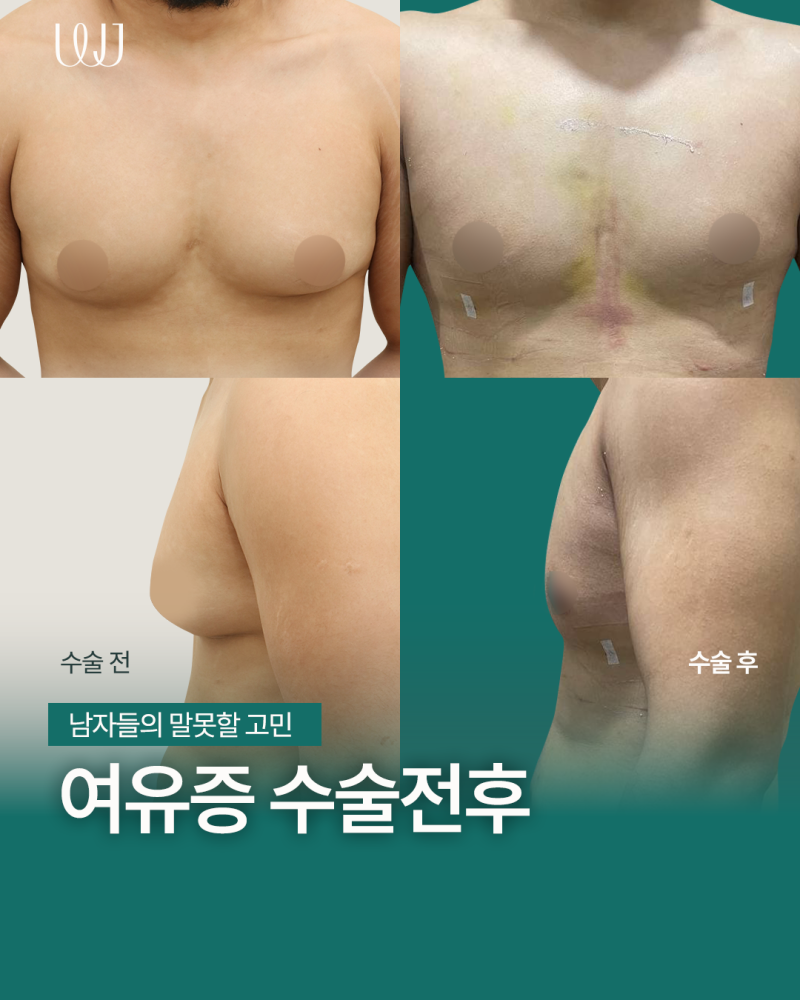
Hello, this is WJ Wonjin Plastic Surgery :D
In today's post, we will share before-and-after results for gynecomastia surgery,
a concern for men that becomes particularly prominent
during the summer season when clothing gets lighter.
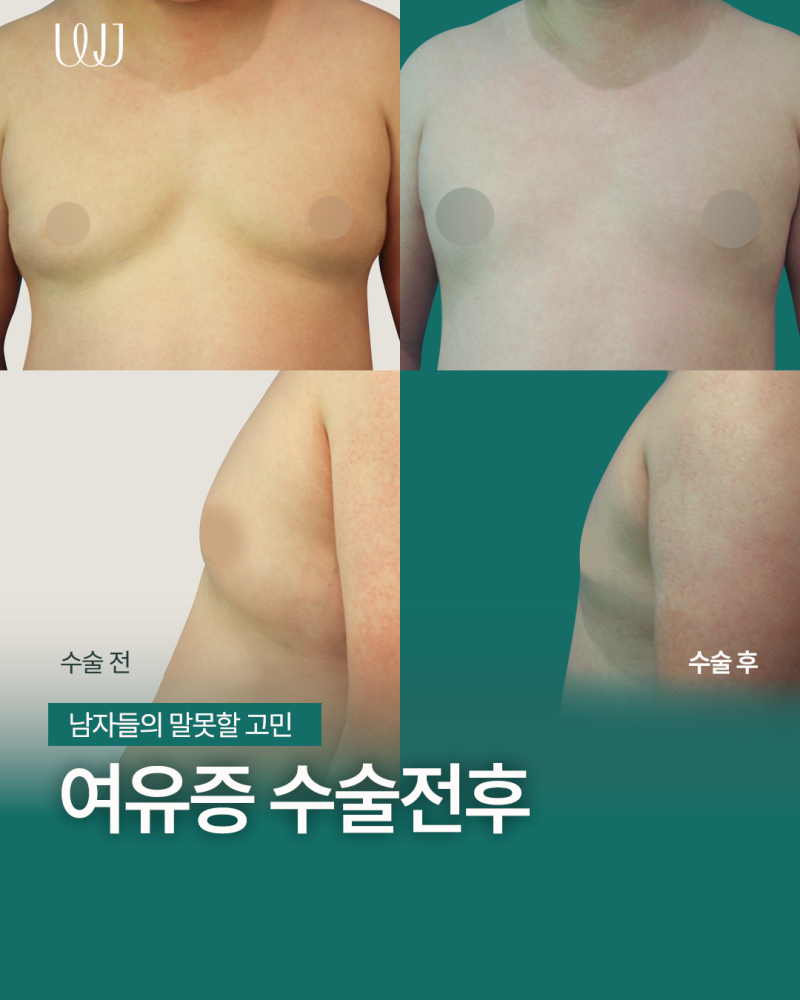
Q. What is gynecomastia?
When glandular breast tissue and fatty tissue accumulate in male breasts,
causing them to enlarge like female breasts,
it is referred to as "gynecomastia."
It occurs when glandular tissue becomes hypersensitive
to female hormones (estrogen),
leading to abnormal breast tissue development.
Recently, due to westernized dietary habits and hormonal imbalances,
the number of men developing enlarged breasts has increased.
When accompanied by the abnormal development of glandular tissue,
it is classified as true gynecomastia.
When there is little to no glandular tissue development
and the enlargement is driven primarily by excessive fat,
it is classified as pseudogynecomastia.
Q. What are the primary causes of gynecomastia?
Hormonal imbalance during adolescence
Medication side effects (steroids, hair loss medications, etc.)
Obesity (estrogen secretion within fat cells)
Liver disease, endocrine disorders
Increased ratio of female hormones in older age
Glandular tissue is responsive to hormones,
which is why gynecomastia often arises
from hormonal imbalances.
Unlike fat, which can be reduced through exercise or dieting,
glandular tissue does not naturally break down,
meaning gynecomastia cannot be resolved
through diet and exercise alone.
In severe cases, gynecomastia is not just an aesthetic concern;
it can also cause psychological stress and a loss of confidence
that interferes with everyday social life.
Because it is difficult to improve through personal effort alone,
it requires surgical treatment for proper correction.
Q. What are the surgical methods for gynecomastia?
CASE 01. Pseudogynecomastia
Liposuction for cases with excess fatty tissue
This method is used when glandular tissue development is minimal and the enlargement is primarily caused by fat accumulation due to obesity.
Through a micro-incision in the armpit, a thin cannula is used
to suction and remove the fatty tissue,
and any asymmetry between both sides of the chest can also be corrected.
CASE 02. True Gynecomastia
Glandular excision for cases with developed glandular tissue
This method is applied to sagging, enlarged breasts caused by glandular proliferation. When the glandular tissue is dense and extensive,
it cannot be eliminated by liposuction alone,
so a semicircular 2–3 cm incision is made along the lower border of the areola
to excise and remove the glandular tissue directly.
CASE 03. Combined Type
When both fatty tissue and glandular tissue are developed
Liposuction + Glandular Tissue Excision
A 2–3 cm incision is made in the armpit or under the areola.
Liposuction is performed to flatten the chest contour,
and the underlying fascia is separated to remove the glandular tissue.
Both liposuction and glandular excision are carried out together.



Frequently Asked Questions
Can gynecomastia be resolved with exercise or dieting?
No, it is difficult to resolve through diet and exercise alone. While exercise can reduce body fat, glandular tissue that has abnormally developed in response to hormones does not break down naturally, making surgical correction necessary.
What are the primary causes of gynecomastia?
Major causes include adolescent hormonal imbalances, obesity, and drug side effects. Medications such as steroids and hair loss treatments, estrogen secreted by fat cells, liver diseases, and an increased ratio of female hormones in older age can all trigger abnormal glandular development.
What is the difference between pseudogynecomastia and true gynecomastia?
They are distinguished by the presence or absence of abnormal glandular tissue development. Pseudogynecomastia refers to breast enlargement caused by excessive fat accumulation with little to no glandular proliferation, whereas true gynecomastia involves the abnormal growth of glandular tissue.
How is pseudogynecomastia treated surgically?
It is treated via liposuction through micro-incisions in the armpit. When glandular tissue is minimal and fat accumulation due to obesity is the primary factor, a thin cannula is used to suction out the fat, allowing for the correction of chest asymmetry as well.
What is the surgical method for combined gynecomastia with both excess fat and glandular tissue?
A combined approach of liposuction and glandular excision is performed. A 2–3 cm incision is made in the armpit or lower areolar margin to flatten the chest via liposuction, after which the underlying fascia is separated to excise the glandular tissue concurrently.